
At BARBRI, we promote the highest quality training for lawyers, which is why we’re proud to collaborate with thought leaders shaping the future of legal practice. In this series of Expert Interviews, we take a deeper dive into conversations with some of these visionaries to find out where the legal industry is now, where they think it is going, and how law firms of the future can be prepared to build success for themselves, their people, and their clients.
Recently, we sat down for an interview with Dennis Kennedy, Principal Investigator at the Kennedy Idea Propulsion Laboratory (KIPL) and an adjunct professor at the University of Michigan Law School, where he teaches the Legal Technology Literacy and Leadership course. He also co-hosts the long-running The Kennedy-Mighell Report podcast on legal technology and received the American Legal Technology Awards’ Lifetime Achievement Award in 2024.
Here are a few takeaways from our conversation with Dennis.
Generate Fast, Verify Hard
Kennedy discussed what law firm leaders should be prioritizing in order to stay competitive in the next few years—and it’s not drafting memos. It’s about insights and advice.
For Kennedy, it comes down to being able to generate fast and verify hard. “That’s the skill that’s wanted,” he said. “Can you explain that you're not just a scrivener, but that you're actually adding value?”
He continued, “AI can do first drafts really well, but clients are looking for judgment. We're looking at verification, especially discipline verification and workflow design. As a client, I'm more willing to pay for that. If I see a time entry that says, ‘Used AI to draft a research memo’ for three hours, and it feels like it should be three minutes, I only want to pay for three minutes. But if I see something that says, ‘Spent time verifying the details and assumptions in the draft generated by AI, verified results, and red-teamed the memo to test how strong the arguments are’ for three hours, I’m perfectly happy to pay for that.”
“That means AI is more about productivity than efficiency. By productivity, I mean better work with less friction; stronger first drafts, faster verification, and more consistent quality, while lawyers remain accountable for judgment.”
The Law Firm/Law School Training Gigantic Disconnect
The right training for lawyers, with the right incentives, needs to be thoughtfully used throughout the firm.
When asked about the biggest gap between what lawyers need to know and what traditional legal education provides, Kennedy again pointed to AI. “In the class I'm teaching, I have students who are going to the biggest law firms in the country, and they're concerned about the impact of AI on jobs,” he said. “They're concerned about what the firms are going to teach them. They're especially concerned about what they're expected to know, because a lot of firms say, ‘We can't wait to get these new associates in, and they can teach us about AI.’ And in law schools, that's not typically what the students are being taught. So there's this mismatch there.”
For established lawyers who are looking to start using AI, there’s no need to wait for those young associates. The best way to build confidence in using this tool is to spend hands-on time with it. “That is a difficult issue in a billable-hours world,” Kennedy acknowledged.
To encourage attorneys, finding the right use case will be very valuable. “I always suggest you find something that you have to do a lot but also have to write the time off for,” he said. If you say, ‘I need to do a transmittal letter that summarizes the key provisions of estate planning, AI is going to do a great first draft. That may be something you can just send on, especially if you train a little bit on what your voice and your style are.”
His conclusion: “The definition of expertise is shifting: less time producing text, more time interrogating outputs, verifying assumptions, and standing behind the work.”
Interrogating the Outputs
Kennedy also peered further into the future about what a successful law firm associate will look like in an AI-embedded world. And that won’t necessarily be someone who is an expert in a particular type of GenAI—it will be someone who excels at what Kennedy calls “output literacy.” After all, tools are constantly changing, and everyone uses AI in different ways. “The notion of training on the basics and tool-specific programs gets dated very quickly,” he said. “My students have told me that they want to learn frameworks, and I could not agree more.”
“I've landed on this word to ‘interrogate’ the AI outputs and be able to understand how to verify them and how much I can rely on them,” said Kennedy. “I also need to be accountable for that, so that if somebody challenges me, I just don't say, ‘Hey, the AI did this’.”
That ability to question and push back against AI results will be an extremely valuable tool for associates and junior lawyers, according to Kennedy. “I want AI to be critical,” said Kennedy. “You can attack it at a fundamental level. So if the first results are a B-, you can and should interrogate it until you get an A- before you take control as the human-in-the-loop.”
Advantages of BARBRI Training
That’s one of the advantages of BARBRI professional skills courses and its training for lawyers, which focuses on frameworks, according to Kennedy.
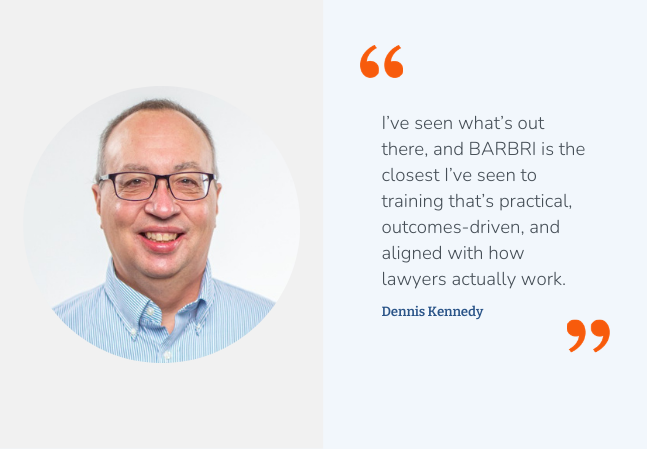
“I’ve seen what’s out there, and BARBRI is the closest I’ve seen to training that’s practical, outcomes-driven, and aligned with how lawyers actually work,” he said. “It’s not about telling AI something that you want it to do. You have to truly have an engaged human in the loop. And that's what I see missing from a lot of AI training, where people say, ‘Here's a prompt that you use.’ But if I use that prompt 10 times, I’ll get 10 different answers.” That’s why my students are right to want to learn frameworks.”
As he said, at the end of the day, AI is just a tool: “It does not operate without a human being behind the control panel.”
Interested in reading more? Fill out the form to read the full article.