
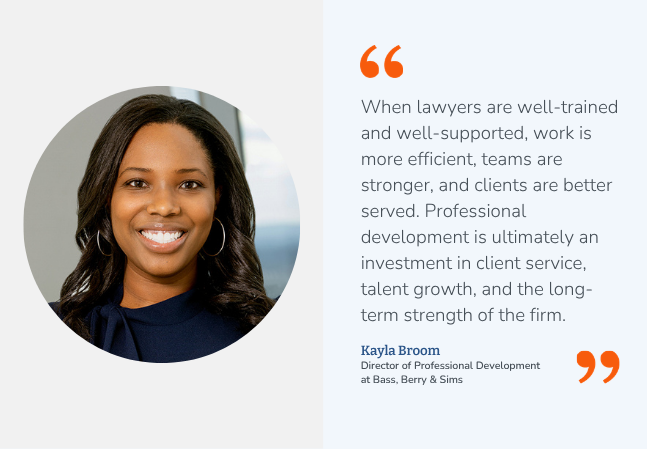
Kayla Broom is the Director of Professional Development at Bass, Berry & Sims. She leads associate integration, training, and development in concert with firm-wide and practice group strategy.
Professional Development at Bass, Berry & Sims
Focused equally on cultivating talent and providing excellent service to clients, the Professional Development (PD) program is designed to advance attorneys’ substantive knowledge, professional and leadership skills, and client service. Broom explains, “Professional development is the structure, support, and coaching that help lawyers build strong substantive skills alongside judgment, communication, and leadership to handle complex and sophisticated matters.”
At Bass, Berry & Sims, associate development is driven through a combination of substantive legal training led by practice groups and intentional programming offered by the PD team. In 2025, the team supported more than 115 substantive training sessions across six practice groups. “Strong technical skills are essential,” Broom says. “But being an excellent lawyer also requires judgment. We focus on helping associates understand not just how to do the work, but why it’s done that way—so they can contribute meaningfully to their teams and deliver outstanding client service.”
The work of the PD team centers on four core pillars: onboarding and integration, training and coaching, staffing, and performance feedback.
Onboarding and integration are especially important for summer associates and new associates. “Our goal in the summer program is to mirror the experience of a junior associate and to intentionally bridge the gap between the academic environment and the realities of law firm practice,” Broom explains. “Our first-year associates arrive with impressive academic backgrounds but learning how to practice law in a firm setting takes guidance, context, and repetition. We’re deliberate about supporting that transition.” Similarly, when new associates join the firm, they participate in a customized orientation and integration program that introduces them to key contacts, practice group resources, and firmwide initiatives that foster engagement and build deeper relationships faster.
Training is designed to reinforce both substantive legal skills and the professional skills that support one’s practice. For example, a practice group may lead a session on drafting, walking through how to approach an assignment, and what strong work product looks like. The PD team may then follow up with programming focused on proactive communication, such as how to incorporate feedback or propose next steps to the assigning attorney. “We’re focused on the ‘why,’” says Broom. “We’re not just defining great performance, we’re coaching and reinforcing feedback that supports how to get there.”
Coaching and feedback are woven into individual PD plans. The PD team meets with most associates at least twice a year to create, review, and/or recalibrate their plans. “Individual plans connect substantive training, performance, and recent feedback,” Broom says. “PD plans help associates be intentional about their development and give them a framework for continued growth.”
The PD team also partners with practice group leadership on staffing to ensure matters are managed thoughtfully and efficiently. Associates provide regular insight into their workload, which allows the staffing team to balance work opportunities while being mindful of capacity. This approach engages associates and promotes development, while keeping client service at the forefront.
Performance feedback rounds out the model. The PD team gathers performance feedback throughout the year and coordinates mid-year and year-end review processes. Not only is the review process informative for each individual, “feedback gives us insight into what’s working and where additional training may be helpful,” Broom explains. “It allows the PD team to address gaps early and adjust in ways that benefit our lawyers, the firm, and the clients we serve.”
What New Lawyers Are Looking For
According to Broom, newer lawyers are eager to better understand how expectations shift from law school to practicing law. New associates are also looking for training, guidance, and support from senior lawyers.
When it comes to collaborating with more experienced lawyers, Broom emphasizes that new attorneys value clarity. They want clear expectations, opportunities to try new skills, and feedback along the way. “Clear expectations and clear feedback help people grow,” she says. “Clear is kind.”
Why Professional Development Matters
Broom views PD as a meaningful investment in the firm’s people and its clients. “A thoughtful professional development model benefits everyone,” she says. “When lawyers are well-trained and well-supported, work is more efficient, teams are stronger, and clients are better served. Professional development is ultimately an investment in client service, talent growth, and the long-term strength of the firm.”
Interested in reading more? Fill out the form to read the full article.