

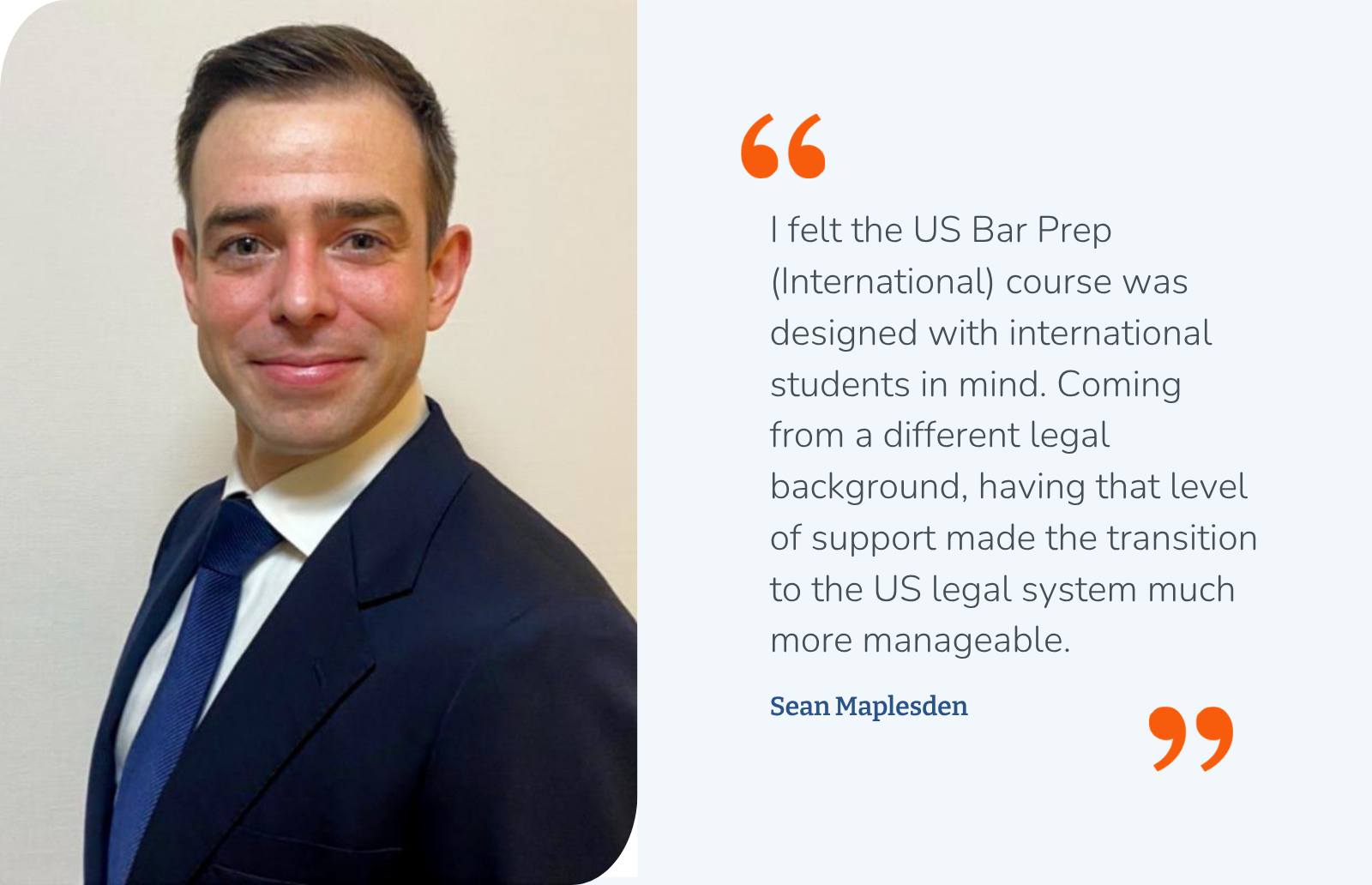
Sean Maplesden is a solicitor admitted in England and Wales who passed the New York Bar Examination in February 2026 with a score high enough for admission in any US jurisdiction using the Uniform Bar Exam (UBE). Early in his career in Tokyo, he negotiated advertising agreements face to face with CEOs at major Japanese companies listed on the Nikkei 225 stock index, gaining first-hand exposure to cross-border business.
Here he shares his journey into international corporate and commercial law, from those early experiences in Tokyo through to qualifying in both England & Wales and New York, and how BARBRI supported him in his qualification journey.
Sean, could you introduce yourself and share what led you to pursue qualification in both England & Wales and New York?
I’ve been living in Tokyo for over ten years, working in international commercial and legal environments. Early in my career, I worked closely with CEOs and senior executives at major Japanese companies negotiating advertising contracts, which gave me a direct insight into international business and transactional matters. That exposure sparked my interest in corporate and commercial law.
Over time, it became clear that qualifying in both England & Wales and New York would give me the strongest foundation for the kind of international corporate career I wanted to build. English and US law underpin a huge amount of global commerce, so having both perspectives felt like the right path.
Can you tell us about your journey into law?
I studied law at the University of Reading in the UK and spent an exchange year at Maastricht University in the Netherlands, focusing on European Legal Studies.
I later moved to Japan and negotiated advertising agreements for content that was published in international outlets such as Newsweek International and The Washington Post. I was working directly with senior leaders from major Japanese companies across industries such as manufacturing, construction, real estate, and renewable energy.
That experience really strengthened my interest in commercial law and international business. It also made me realise I wanted to move into law more formally, which led me to qualify as a solicitor through the SQE route.
What motivated you to pursue dual qualification in the UK and the US?
After completing the SQE, I worked at a law firm in Tokyo that advised international clients on corporate matters and cross-border transactions. While I was there, I worked with a partner who was dual-qualified in Japan and New York, and seeing how valuable that combination was really reinforced my decision to pursue the New York Bar.
Both England & Wales and New York qualifications are widely recognised, especially in international corporate and transactional work. Having that dual perspective not only deepens your understanding of different legal systems but also gives you more flexibility to work across jurisdictions.
For me, it was about being able to contribute meaningfully to cross-border matters and collaborate with international teams, particularly across markets such as London, New York, and Tokyo.
What were the biggest challenges of preparing for the SQE and the New York Bar, and how did you approach them?
Each examination had its own challenge. SQE1 was demanding because of the format – 360 multiple-choice questions across four long sessions – with very tight time pressure. At the time I sat the exam, there were only two days between the assessment papers, so building both accuracy and stamina was essential.
What really helped was practising full-length mock exams under real exam conditions. Doing back-to-back sessions allowed me to get used to the focus required across the full day. BARBRI’s question bank and structured approach played a big role in helping me manage both timing and accuracy.
SQE2 was a different challenge altogether. It combines written assessments, including contract drafting, research, and case analysis– with oral assessments in advocacy and client interviewing. I felt comfortable with the interview component because of my past experience interviewing and negotiating with CEOs in person, but advocacy was completely new to me.
To prepare, I recorded myself, reviewed my performance, and focused on practising early. Having a clear structure from BARBRI made it easier to stay on track, and I was pleased to achieve strong results in the advocacy component, including a Superior grade in the Criminal advocacy assessment.
For the New York Bar, the challenge was adapting to a new legal system, especially understanding the distinction between federal and state law. Staying disciplined while being flexible in how I approached a different framework was key.
Why did you choose BARBRI for both your SQE and New York Bar preparation?
I used BARBRI for both SQE1 and SQE2 and passed on my first attempt, so continuing with them for the New York Bar felt like a natural decision.
For me, the tutors were a standout. Their explanations, feedback, and approach to exam technique made a big difference in helping me understand how to approach each assessment. They were also approachable and supportive throughout, which really mattered during what were often demanding periods of study.
How did BARBRI support you, and what stood out about the Extended US Bar Review?
The structured approach to learning was really valuable, especially when managing the breadth of material. The graded assignments and personalised feedback helped me stay on track and understand where I needed to improve.
Access to AdaptiBar was also a key part of my preparation. The questions closely reflected the style and difficulty of the real exam, so it was a great way to build confidence and familiarity.
I also felt the course was designed with international students in mind. Coming from a different legal background, having that level of support made the transition to the US legal system much more manageable.
Now that you’ve completed both pathways, how do you see this shaping your career?
Dual qualification gives me a strong foundation for working in international corporate and transactional law. It’s still relatively uncommon, and it positions me well for roles that involve cross-border work and multi-jurisdictional teams.
It means I can contribute to matters that span different legal systems and support clients operating internationally, particularly across markets such as London, New York, and Tokyo. That aligns closely with my long-term goal of building a career that moves across jurisdictions.
What advice would you give to others considering the SQE, the US Bar, or both?
Be realistic about the level of commitment involved and give yourself enough time to prepare properly. Both pathways require consistency, discipline, and a willingness to adapt to different styles of assessment.
Having a preparation provider that offers structured materials, clear guidance, and reliable support can make a big difference– especially when you’re balancing the intensity and volume of the exams.
Most importantly, keep the long-term goal in mind. These qualifications can open up opportunities internationally, and while the process is demanding, the perspective and growth you gain along the way make it incredibly worthwhile.
Interested in Our Prep Courses?
Read more here:
BARBRI US Bar Prep (International)
For more student stories, see our Student Stories page.
Interested in reading more? Fill out the form to read the full article.